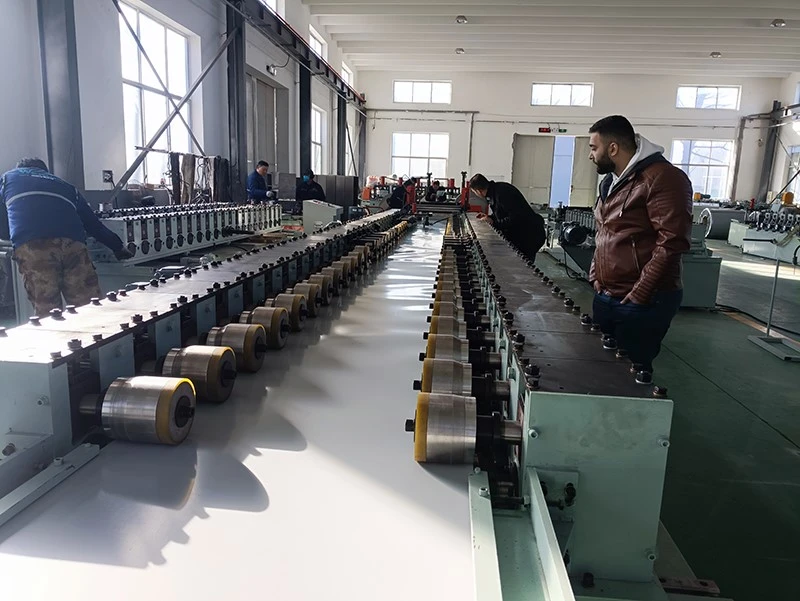
Roll forming is a cold-forming process that utilizes the plastic deformation characteristics of materials to shape complex components through the rolling and squeezing action of forming rolls. In 2025, the global market for roll forming machines reached $577 million, with China serving as the largest market (holding approximately a 21% share); the technology is primarily applied in industries such as automotive and construction, with the automotive sector being the largest application area.
The roll forming process originated in the 19th century, and the first specialized roll forming equipment was developed in the United States in 1910. Professor George Winter conducted research on roll forming theory in 1939. By the mid-20th century, equipment integration levels advanced rapidly, leading to the technology's combination with processes such as stamping and welding. Entering the 21st century, systems for optical cross-section measurement and rapid in-line tooling changeover were integrated to meet demands for high flexibility and precision. The process was introduced to China in the late 20th century.
Roll forming is a process in which metal coils or strips undergo continuous transverse bending through a series of sequentially arranged forming rolls to produce profiles with specific cross-sections. The deformation occurs via line contact and proceeds continuously and incrementally; this requires relatively low forming force and results in high production efficiency. The process is particularly well-suited for the mass production of long, constant-cross-section components-with annual outputs exceeding one million units-and can be combined with punching, welding, cutting, and other processes to form continuous production lines.
Roll forming is primarily used for the mass production of parts in sectors such as automotive, construction, and logistics equipment. In recent years, the process has played a pivotal role in automotive lightweighting, finding wide application in components such as crash beams, door impact bars, seat rails, and longitudinal member reinforcements (rocker panels). In the new energy sector, roll forming is used to manufacture high-strength steel battery pack housings, achieving a balance of high performance and quality with low costs and emissions. Compared to traditional methods, the roll-formed steel housing process offers advantages in terms of lightweighting, material utilization, and cost control.