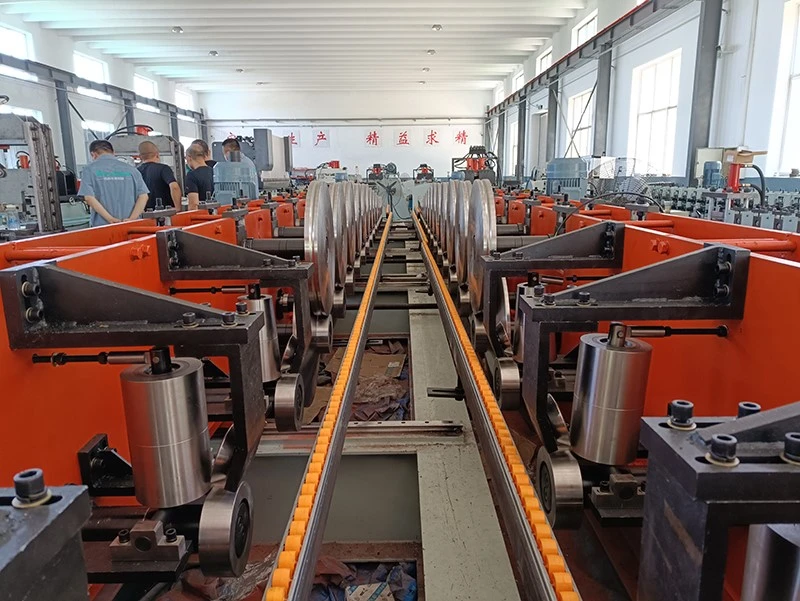
Roll forming is an advanced sheet metal forming process characterized by material savings, energy efficiency, and high productivity. Due to its low cost, high efficiency, and flexibility, it is widely used in applications requiring mass production, long components, complex cross-sections, and tight tolerances; it is a key technology for achieving lightweighting, energy conservation, emission reduction, and enhanced safety.
In the automotive manufacturing sector, roll forming is extensively used to produce components such as door impact beams, rocker panels, window frames, seat rails, bumpers, and truck chassis. It is particularly well-suited for forming advanced high-strength steel (AHSS), enabling tighter bending radii. The process offers advantages such as low initial equipment investment, high production efficiency, high material utilization, minimal springback, controllable precision, and consistent product quality.
In the construction industry, roll forming is employed to manufacture products such as color-coated steel doors, windows, and profiled sheets. These products often require complex cross-sectional profiles and must meet functional requirements like thermal insulation and waterproofing. To protect the surface of the color-coated steel, a lock-seaming process is frequently used when forming closed-section profiles.
In sectors such as new energy, aerospace, and rail transportation, roll forming serves as a vital technology for achieving lightweighting, energy conservation, emission reduction, and improved safety. Advanced dynamic roll forming systems integrate computer-controlled, multi-degree-of-freedom roll stands, allowing the profile's cross-section to vary along its length to create 3D profiles, thereby expanding the technology's application scope .